
Hydration Calculator: Are You Drinking Enough Water Per Day?

Find out if you’re drinking enough with our free hydration calculator. Enter your weight, height, activity, climate and daily drinks to see your ideal intake, hydration percentage and calories from liquids. Get clear, personal results in seconds, with no signup needed, and your details stay completely private in your browser.
1 About you
2 Lifestyle
3 Drinks
4 Results
Tell us about you

Gender, age, weight and height help estimate your daily water need.

Kidneys process ~180 L of blood daily and make about 1–1.5 L of urine.

Age (years)
Weight
Weight unit

About 60% of your body is water.

Height
Height unit

Your blood is about 83% water.

Your lifestyle

Activity and climate change how much water you lose each day.

Good hydration supports focus and physical performance.

Heat, humidity and altitude increase water loss through sweat.

Daily liquid intake

How many glasses of each drink do you usually have in a day?

Water is the only naturally zero-calorie drink.

Your results

Based on your profile and drinking habits.

Ideal intake
—
Your intake
—
Typical loss
—
From food
—
Hydration vs ideal 0%
Hydration status
—
Calories from liquids
—
Hint
—

Estimate only — not medical advice. People with kidney, heart, or fluid-restriction conditions should follow a doctor’s guidance.

Quick answer: a hydration calculator compares the fluids you actually drink in a day with the amount your body needs, then tells you where you stand as a percentage. Most healthy adults land somewhere between 2 and 3 litres of total fluid a day, but your own figure depends on your weight, height, age, activity and climate. Use the hydration calculator above to see yours.

Unlike a basic water target, this hydration calculator also looks at your real drinking habits. You tell it how many glasses of water, coffee, juice or soda you have, and it works out whether you are under, close to or over your ideal. Everything runs in your browser, so your details are never stored or sent anywhere.

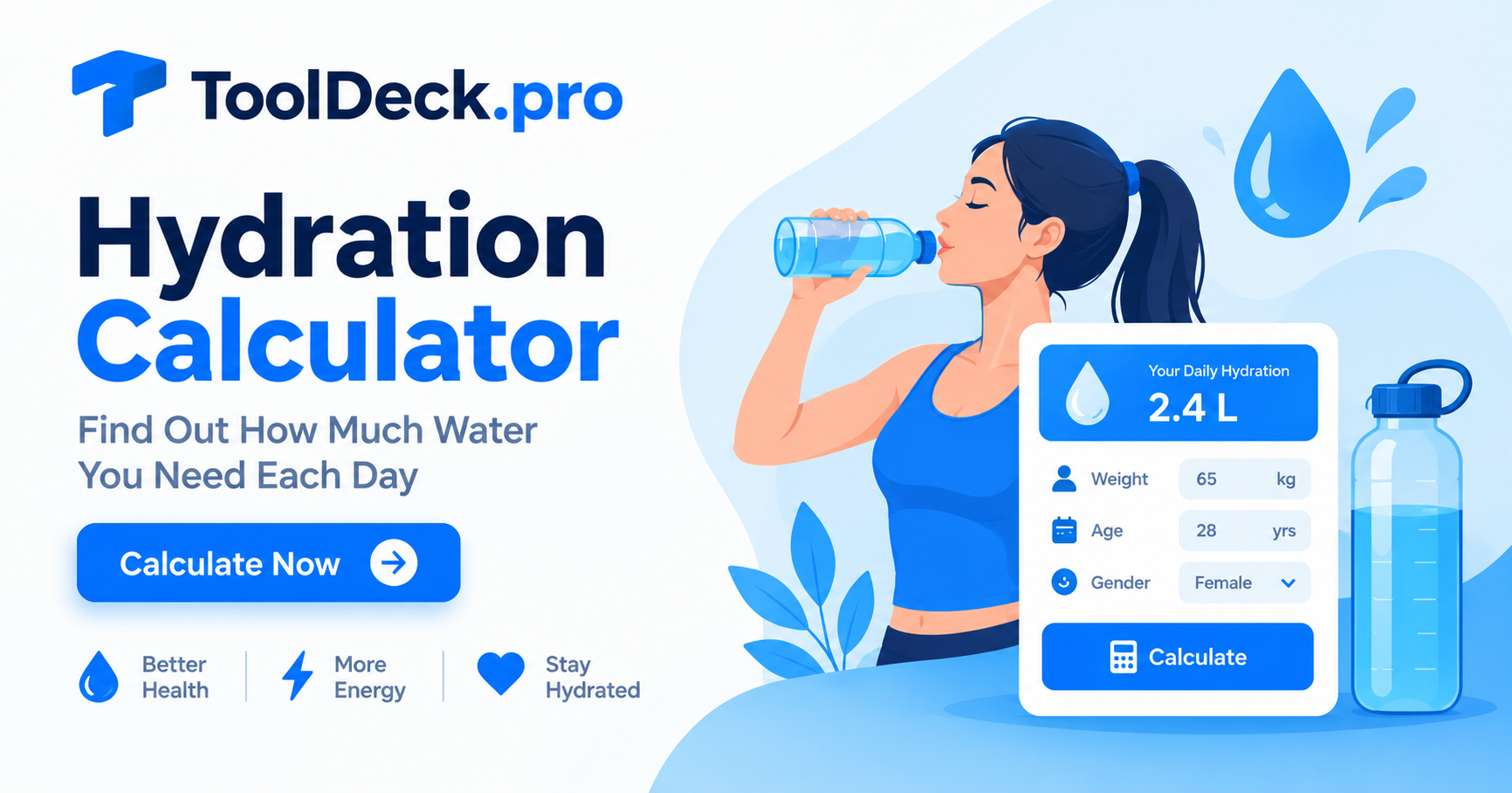
Hydration Calculator banner showing a woman drinking water next to an interactive daily water intake form calculating 2.4 Liters

What Is a Hydration Calculator?

More than a single number

Plenty of tools give you one daily target and stop there. A hydration calculator goes a step further. It builds your ideal intake from your body and lifestyle, then measures your current intake against it. That second step is what makes it useful, because knowing you should drink 2.4 litres means little if you have no idea how much you drink now.

What the tool measures

The calculator asks about you, your lifestyle, your drinks and your location. From those answers it estimates your ideal intake, your current intake, the water you typically lose, the share that comes from food, and a hydration status. It also shows the calories hiding in your drinks, which often surprises people.


How to Use the Hydration Calculator

The tool walks you through four short steps:

  1. About you: choose your gender, add your age, weight and height, and tick pregnancy or breastfeeding if it applies.
  2. Lifestyle: pick how often you are active, from rarely to daily, and select your country or climate. Heat, humidity and altitude all change how much water you lose.
  3. Drinks: enter how many glasses of each drink you have in a normal day, using millilitres or fluid ounces.
  4. Results: read your ideal intake, your real intake and your hydration status, then print the page if you want a copy.

Be honest here; rounding up gives a flattering number, not an accurate one.

Understanding Your Results

Once you press Next, the results page shows several figures. Here is what each one means.

ResultWhat it tells you
Ideal intakeThe total fluid your body needs for your size, activity and climate
Your intakeThe fluid you actually drink, added up from your drink list
Typical lossThe water you normally lose through urine, sweat and breathing
From foodThe portion of your fluid that meals and snacks already supply
Hydration vs idealYour intake as a percentage of your ideal
Calories from liquidsThe energy you take in through drinks alone

Ideal intake versus your intake

The gap between these two numbers is the whole point. A small gap means your habits already suit your body. A large one tells you exactly how many extra glasses to add, or how much sugary liquid to swap for water.

Typical loss and water from food

Your body loses water all day, even when you sit still. Food usually covers around a fifth of your fluid, so a diet heavy in fruit, vegetables and soup lowers the amount you need to drink. A diet of dry, salty snacks does the opposite.

How to Calculate Your Daily Water Intake Yourself

If you like to check the maths, there is a quick way to calculate daily water intake by weight. Multiply your body weight in kilograms by 30 to 35 ml, or your weight in pounds by 0.5 oz. A person who weighs 70 kg lands at about 2.1 to 2.45 litres a day.

That method is a good starting point, but it ignores height, climate and what you already drink. If you only want a target, try our water intake calculator, which gives a personal daily number in litres, ounces and glasses. If you want to know how your habits compare with that target, the hydration calculator on this page finishes the job.

Do All Drinks Count?

Mostly yes. Tea, coffee, milk and juice all add to your fluid total, but they differ in calories, sugar and caffeine. Plain water is the only option that adds hydration with nothing extra.

Drink (250 ml)Approx. caloriesNotes
Water0Best everyday choice
Black coffee2Counts towards fluid, mild caffeine
Unsweetened tea2Counts towards fluid, mild caffeine
Sports drink60Useful only during long, hard exercise
Cola100Hydrates, but adds a lot of sugar
Orange juice110Vitamins, but plenty of natural sugar
Whole milk150Filling, with protein and fat

Why calories from liquids matter

Liquid calories are easy to miss because they do not make you feel full. Three sugary drinks a day can add a few hundred calories without any effort. If you are working on your weight, trimming these is one of the simplest changes you can make.

What Your Hydration Percentage Means

The “hydration vs ideal” figure compares your intake with your ideal. This rough guide shows how to read it.

Hydration vs idealWhat it usually meansWhat to do
Below 70%Well under your needsAdd a glass with each meal and one on waking
70% to 90%Slightly lowSip steadily and carry a bottle
90% to 110%On targetKeep your current routine
Above 110%More than you needEase off and spread drinks out

Treat these bands as a guide, not a diagnosis.

Factors That Change How Much You Need

The hydration calculator accounts for these, because your ideal intake is not fixed:

  • Climate and altitude: hot, humid or high-altitude places make you lose more water.
  • Activity: regular training raises your needs, especially on workout days.
  • Pregnancy and breastfeeding: both raise fluid needs, and breastfeeding raises them the most.
  • Age: thirst signals weaken with age, so older adults can fall behind without noticing.

Practical Ways to Improve Your Hydration

You do not need a complicated plan. Try these habits:

  • Drink a glass of water as soon as you wake up.
  • Keep a bottle on your desk and refill it at set times.
  • Eat water-rich foods such as cucumber, oranges and soup.
  • Swap one sugary drink a day for water or unsweetened tea.
  • Drink a glass about 20 minutes before meals if you are trying to lose weight.
  • Rerun the hydration calculator after a week to see your percentage improve.

Hydration also connects to other habits. Good sleep supports appetite and recovery, so our sleep calculator can help you plan a bedtime that fits full sleep cycles. If you want to see how your weight sits in a healthy range, try the BMI calculator. Since fluid needs shift through life, it also helps to know your exact age, which our age calculator works out in years, months and days.

Signs of Dehydration and Overhydration

Your body gives clear signals once you know what to look for.

  • Possible dehydration: dark yellow urine, dry mouth, headache, tiredness, dizziness or trouble concentrating.
  • On track: pale yellow urine, steady energy and only occasional thirst.
  • Possible overhydration: frequent clear urine, nausea or a bloated feeling after drinking very large amounts quickly.

Drinking far too much in a short time can dilute the sodium in your blood, which is dangerous. Spread your drinks across the day instead of forcing them down at once. If you have kidney problems, heart conditions or a doctor-advised fluid limit, follow your medical advice rather than any calculator. This tool gives an estimate only and is not medical advice.

Final Thoughts

Knowing your target is only half the story. The other half is knowing how your daily habits measure up, and that is where a hydration calculator earns its place. Run the numbers, pick one or two small changes from the tips above, and check again in a week. You can also browse more free online calculators on ToolDeck for health and everyday tasks.

Frequently Asked Questions

What is a hydration calculator?

It is a tool that estimates your ideal daily fluid intake, compares it with what you actually drink and shows how close you are as a percentage.

It uses common formulas and your own answers, so it gives a sound estimate. It cannot measure your sweat rate or health conditions, so use thirst and urine colour as a cross-check.

Most healthy adults need roughly 30 to 35 ml per kg of body weight, including water from food. For a fuller answer, use the hydration calculator above, which also factors in height, climate and activity.

Yes. Coffee and tea add to your fluid total, although water is still the best choice for most of it.

Yes. Tick the matching box in the first step and the result adjusts for the extra fluid you need. Check with your midwife or doctor for personal advice.

Learn More:

Why BMI Is Important for Your Weight and Overall Health

Advanced Age Calculator vs Age Calculator – What’s the Difference?

In this page, you learn the key differences between an advanced age calculator and a basic age calculator. It explains how advanced calculators provide more accurate and detailed age results, support medical and professional needs, and help users make better decisions compared to simple age calculation tools.

Advance Age Calculator for Medical Purposes

Medical age calculators help doctors and patients know the exact age of a person. They are used for giving correct medicine doses, tracking child growth, planning vaccinations, and managing pregnancy. Different types include chronological, biological, gestational, and pediatric dosing calculators. These tools save time, reduce mistakes, and make healthcare safer and more accurate.