Select your age range
Recommended sleep: —
Pick an age group to see your recommended hours.
Sleep Schedule

Wondering what time you should go to bed, how much sleep you need, or when you should wake up to feel more rested? Our free Sleep Calculator helps you estimate a suitable bedtime or wake-up time based on your target sleep duration and daily schedule.
Whether you are trying to build a better sleep routine, determine if you are getting enough sleep, or understand how sleep cycles work, this guide explains everything you need to know about calculating your sleep time.
Use our Sleep Calculator to get started, then learn how sleep duration, sleep cycles, age, and sleep habits can affect how rested you feel.
A sleep calculator is a simple tool that helps you estimate when to go to sleep or when to wake up based on the amount of sleep you want to get.
For example, if you need to wake up at 6:30 AM and want to get approximately 8 hours of sleep, you can work backward from your wake-up time: 6:30 AM − 8 hours = 10:30 PM. If you normally need around 15 minutes to fall asleep, you may want to get into bed around 10:15 PM.
Just as tools like a BMI calculator can provide a quick estimate for your health and wellness, a sleep calculator offers a simple estimate to help plan your sleep schedule. Some sleep calculators also use estimated sleep-cycle timing.
Some sleep calculators also use estimated sleep-cycle timing. However, sleep cycles are not exactly the same length for everyone or throughout the entire night. Sleep cycles generally restart every 80–100 minutes, so cycle-based calculations should be treated as estimates rather than exact predictions.

One of the most common sleep questions is, “How much sleep do I need?” The answer depends largely on age, although individual sleep needs can vary. Most healthy adults should regularly get at least seven hours of sleep, while teenagers and children generally need more.
Age Group | Recommended Sleep |
Newborns (0–3 months) | 14–17 hours |
Infants (4–12 months) | 12–16 hours |
Toddlers (1–2 years) | 11–14 hours |
Preschoolers (3–5 years) | 10–13 hours |
Children (6–12 years) | 9–12 hours |
Teenagers (13–18 years) | 8–10 hours |
Adults | 7 or more hours |
Older adults | Needs vary individually |
These ranges are general sleep-duration recommendations. Individual needs can differ, and sleep quality and consistency also matter.
Children between 6 and 12 years old generally need 9–12 hours of sleep per 24 hours.
A 13-year-old falls within the teenage recommendation of approximately 8–10 hours per night.
Teenagers aged 13–18 are generally recommended to get 8–10 hours of sleep each night.
For most adults, 5 hours of sleep is not enough when it becomes a regular habit. Healthy adults are generally recommended to get at least seven hours regularly.
Six hours may happen occasionally, but it is generally below the recommended amount for healthy adults when maintained regularly.
For many adults, 7 hours meets the recommended minimum, although some people function better with more.
Eight hours is a healthy amount of sleep for many adults. If you still feel exhausted after eight hours, sleep quality and other factors may be involved.
The best bedtime depends on when you need to wake up and how much sleep you need. The examples below are based on sleep duration alone.
Wake-Up Time | 7 Hours | 8 Hours | 9 Hours |
5:00 AM | 10:00 PM | 9:00 PM | 8:00 PM |
6:00 AM | 11:00 PM | 10:00 PM | 9:00 PM |
6:30 AM | 11:30 PM | 10:30 PM | 9:30 PM |
7:00 AM | 12:00 AM | 11:00 PM | 10:00 PM |
8:00 AM | 1:00 AM | 12:00 AM | 11:00 PM |
If you want approximately 8 hours of sleep and need to wake at 6:00 AM, a basic calculation gives you a bedtime of around 10:00 PM. Allow extra time if you typically take longer to fall asleep.
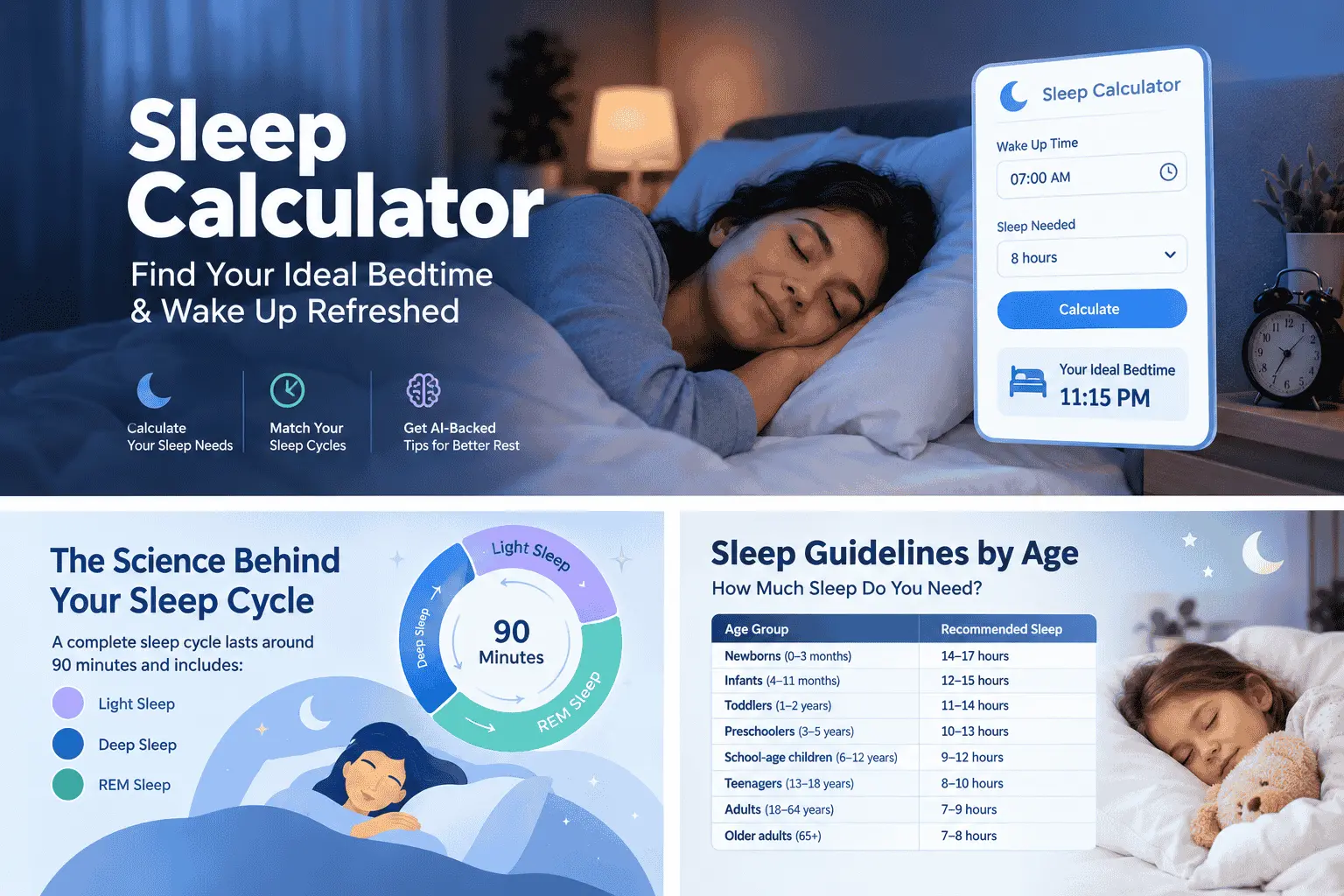
If you need to wake at 7:00 AM and want about 8 hours of sleep, a basic calculation gives you a bedtime of around 11:00 PM.
Your ideal wake-up time depends on your daily responsibilities and how much sleep you need. For adults, regularly getting enough sleep is more important than trying to force sleep into an exact number of 90-minute cycles.
A sleep cycle is a period during which the brain moves through different stages of sleep. Sleep consists of non-REM sleep and REM sleep. A typical cycle is approximately 80–100 minutes, although the exact duration varies.
This is the lightest stage of sleep as you move from being awake to asleep.
You are more clearly asleep, while body and brain activity continue to change.
Stage 3 is commonly called deep sleep or slow-wave sleep and is particularly prominent earlier in the night.
REM stands for Rapid Eye Movement. Brain activity increases during REM sleep, and dreaming commonly occurs. REM periods tend to become longer later in the night.
Sleep cycles are often described as lasting about 90 minutes, but this is only an estimate. A typical cycle may last approximately 80–100 minutes, and cycle length can vary throughout the night.
Most people experience approximately four to six sleep cycles during a typical night. The number of cycles is less important than getting enough quality sleep for your individual needs.
The idea that everyone has an exact 90-minute sleep cycle is an oversimplification. Sleep cycles vary between people and can change during the same night. If a sleep-cycle calculator uses 90-minute intervals, its results should be considered rough estimates rather than precise biological predictions.
Adequate sleep supports attention, concentration, learning, memory, emotional regulation, daytime alertness, physical health, and overall quality of life.
Ongoing insufficient sleep is associated with a range of physical and metabolic health risks.
Sleep loss can affect focus, reaction time, memory, learning, decision-making, and daytime alertness.
Poor or insufficient sleep can affect mood and emotional regulation.
Getting eight hours of sleep does not always guarantee that you will wake up feeling refreshed. Possible reasons include poor sleep quality, frequent nighttime awakenings, an inconsistent schedule, stress, circadian disruption, or an underlying sleep problem.
Try to go to bed and wake up at approximately the same times each day.
Use quiet activities such as reading or gentle stretching to wind down.
Caffeine can interfere with sleep, particularly when consumed later in the day.
Light exposure affects the body’s circadian system, so darker conditions at night can support the transition toward sleep.
A dark, quiet, and comfortable bedroom can support better sleep conditions.
Plan enough time for regular, quality sleep rather than relying on the minimum amount you can manage.
Tool | Main Purpose |
Sleep Calculator | Estimates bedtime or wake-up time based on target sleep duration. |
Bedtime Calculator | Usually works backward from a desired wake-up time. |
Sleep Cycle Calculator | May estimate timing using approximate sleep-cycle durations. |
Start by asking three questions: What time do I need to wake up? How much sleep do I need? What bedtime gives me enough opportunity to get that sleep consistently?
Our Sleep Calculator can help you make these calculations quickly. Once you have an estimated bedtime, focus on consistency, sleep quality, and healthy habits.
Most healthy adults should regularly get at least seven hours of sleep per night. Individual sleep needs can vary.
Sleep needs generally decrease as children grow. Children 6–12 generally need 9–12 hours, teenagers 13–18 need 8–10 hours, and healthy adults should regularly get at least 7 hours.
Five hours is generally not enough for most adults when it becomes a regular pattern.
Six hours is below the recommended amount for healthy adults when maintained regularly.
Seven hours meets the recommended minimum for healthy adults, although some people may need more.
Eight hours is an appropriate amount for many adults, but sleep quality and individual needs also matter.
Your bedtime depends on your desired wake-up time and how much sleep you need.
Your wake-up time should fit your daily schedule while allowing enough time for regular, quality sleep.
A typical sleep cycle lasts approximately 80–100 minutes, although the exact length varies.
REM means Rapid Eye Movement. It is a sleep phase characterized by increased brain activity, rapid eye movements, and frequent dreaming.
Most people experience approximately four to six sleep cycles during a typical night.
A sleep calculator can be useful for estimating bedtime and wake-up times, but it cannot precisely predict individual sleep patterns.
Possible reasons include poor sleep quality, inconsistent timing, frequent awakenings, stress, circadian disruption, or an underlying sleep problem.
Short naps can improve alertness for some people, but long or late naps may interfere with nighttime sleep.
The best schedule provides enough sleep, fits your daily responsibilities, and can be followed consistently.
This Sleep Calculator and article are provided for general educational and informational purposes only. Calculator results are estimates and are not a medical diagnosis or a substitute for professional medical advice. Sleep needs vary from person to person. If you regularly experience severe daytime sleepiness, persistent difficulty sleeping, loud snoring, breathing interruptions during sleep, or other ongoing sleep problems, speak with a qualified healthcare professional or sleep specialist.